

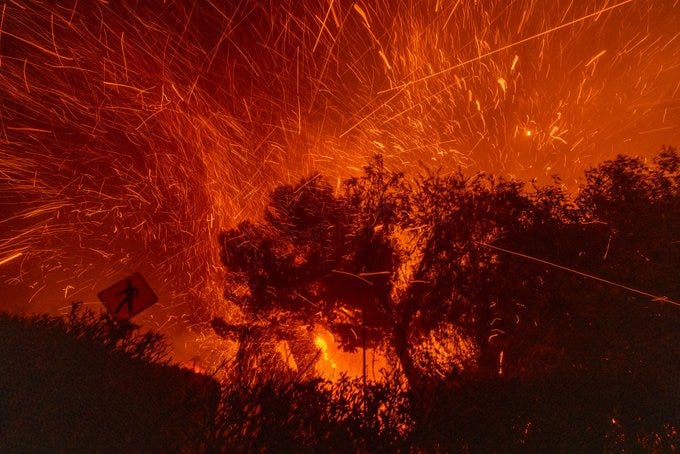
On January 7, my sister-in-law forwarded an email to the family from meteorologist and local hero Edgar McGregor, talking about the wind event we were expecting in Southern California. I remember his warning clearly: “If a wildfire breaks out, it will not be stopped.” I hired our landscapers to trim our trees in case the wind was enough to take one down, which they generously did despite the dangerous conditions. When the Eaton Fire ignited in the Canyon around 6:15 pm that night, my wife and I game-planned on her drive home from work. We watched closely as the fire spread east over the next few hours, prepared a go-bag of important documents, and went to sleep around 11:30 pm as the fire perimeter moved further away from us.
Around 1:30 am, Ring alerts from neighbors posting about the fire woke my wife up. The winds had shifted in the middle of the night, and the fire had changed direction. After trying to make sense of the situation, she woke me up, and we out to our front yard where we could now see flames down the street. The County never issued an official evacuation notice for our area, but the smoke was too heavy to stay, so we left. We drove to my in-laws’ house and stayed up watching the news, checking Ring and Watch Duty, and cycling between hope and dread. On the morning of January 9, we confirmed our house had burned down, and we began the long process of grieving and recovering.
Maslow and Disaster Recovery
When you are directly affected by a natural disaster, the steps in your recovery intuitively follow Maslow’s hierarchy of needs. You secure your bodily needs first — food, shelter, clothing, sleep — then your personal safety needs. As various communities or peer groups rally around to help provide support, you aren’t really able to appreciate the value of being a part of something bigger than yourself until your needs at the base of the pyramid are met. You have to get your sea legs. With time, you can turn your attention back to the people who surround you.
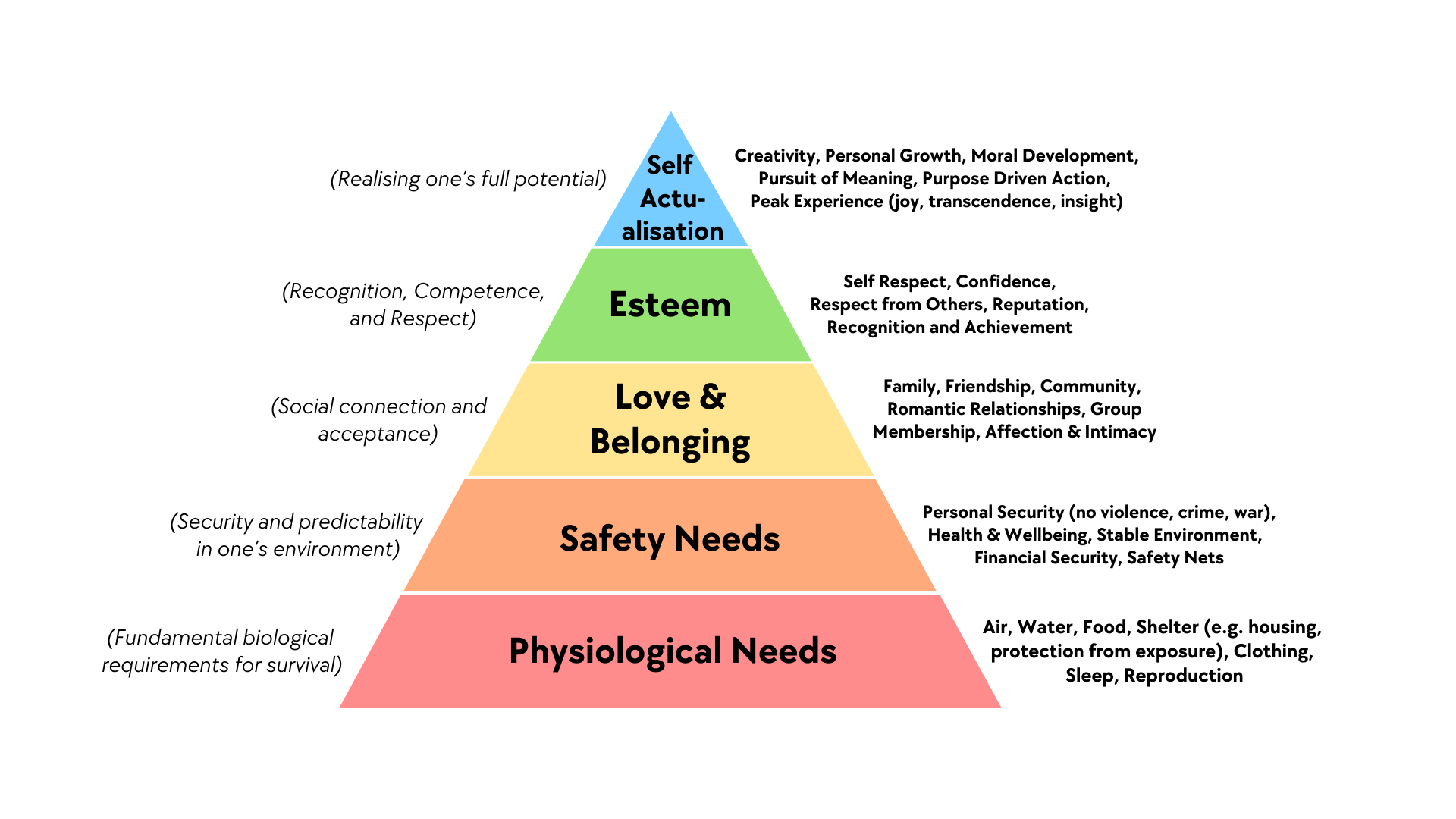
Community support needs operate almost at an inverse to Maslow’s pyramid. The most important relationships form the smallest group, your most intimate, immediate relationships — family, direct neighbors, pets. This gradually expands outwards into larger, more geographically and relationally diverse groups — churches and synagogues, recreational sports teams, community gardens, the city, county, state. The further out you go, the more diffuse the energy and momentum gets due to simple practical issues like and managing networks spread across miles and miles.
Also, the further you get further away from the epicenter, the harder it is to wrap your mind around the needs of the community. Any and all support is meaningful, and everyone’s financial and emotional generosity makes a difference, but there are varying levels of impact. FEMA and Red Cross do great work, but they just aren’t able to support the way a close-knit network of mutual aid can.
Trust is correlated with proximity.
The Moral Circle in a Time of Crisis
Over the past six months, we have had a close look at how communities organize, develop and grow, and what has stuck with me the most is how crisis reshapes our capacity to express moral concern.
Keep reading with a 7-day free trial
Subscribe to Empty Words to keep reading this post and get 7 days of free access to the full post archives.